
Quick answer: Most freeze-related failures in GTA industrial buildings start with forgotten water: a drained cooling tower with no heat trace on its make-up line, a compressed-air drop that nobody blew down, a yard fire line with a dead-leg sprinkler branch, or a washdown station left charged. This seasonal checklist walks through the systems that freeze first, the shutdown steps to complete before the first hard freeze (typically mid-November in the GTA), and what to document so spring start-up goes smoothly.
The first hard freeze in the Greater Toronto Area usually arrives between mid-November and early December, and with it comes the part of the year when industrial plumbing failures stop being gradual. Cooling tower basins, compressed-air drops, outdoor process lines and yard piping do not give much warning — water trapped in a dead leg or a low-point drain that was never blown down turns to ice, expands, and splits pipe and fittings overnight. The repair is rarely just the pipe: expect a flooded pit, a down production line, and an emergency call-out during a cold snap when materials and crews are stretched thin.
A pre-winter shutdown review is how facility and plant engineers get ahead of that. It is a walkdown of the water-bearing systems that will see freeze exposure over the winter, a short list of isolation, drain-down and heat-tracing tasks, and a record you can hand to the next shift. The sections below are organized by system, roughly in the order that failures tend to show up, and each one ends with the actions that matter before freeze-up.
Why industrial buildings need a pre-winter shutdown review
Commercial buildings freeze pipes too, but industrial facilities carry a different risk profile. Water is not only potable and heating: it runs through process cooling loops, compressors, condensate returns, dust-suppression feed lines, washdown stations, fire protection and storm systems — often in unheated mezzanines, pits, penthouses and yards. Four factors drive most of the damage:
- Trapped water in dead legs. Branch lines capped after equipment changes, unused equipment drops and low points that never drain are the classic failure point. The main line may be fine while a forgotten 25 mm branch splits.
- Heat trace that fails silently. Heat-tracing cable and its insulation envelope are out of sight and out of mind until the night it matters. If the controller, ground-fault protection or the cable itself failed last winter, nothing tells you until the line freezes.
- Liquid-cooled equipment that shuts down for the season. Water-cooled compressors, chillers and welding sets that stop running in winter remove the constant flow that was keeping marginal lines from freezing. A line that survived last winter with process flow in it can freeze this winter once that flow stops.
- Small leaks become bigger problems in winter. A weeping fitting that drips harmlessly in September can heave a walkway or coat a yard in ice in January. Fix small leaks during the shutdown window while access and weather cooperate.
The human side matters too. Work near frozen systems and outdoor winter repairs carries real cold-stress risk for crews, and CCOHS guidance on working in cold environments is a useful reference when scheduling outdoor freeze-protection or emergency work. It also affects how far you can push winter repairs: there is a practical limit to how long a crew can safely work on an exposed line in January, which is exactly why this work belongs in the fall.
Freeze-up timing varies by year, so anchor the schedule to something official rather than folklore: Environment and Climate Change Canada publishes seasonal forecasts and climate information you can use to time the shutdown window each fall. And when excavation is part of the plan — say a yard line that must be replaced before freeze-up — remember that Ontario One Call locates take a few business days, so book them before the calendar gets tight.
Cooling tower and condenser-water shutdown
Evaporative cooling towers are the most freeze-exposed asset on most industrial sites. A tower that runs all winter (common on process cooling loads) is a winter-operations problem; a tower that shuts down for the season is a shutdown problem. This checklist is for the shutdown case.
Before the first hard freeze:
- Drain the basin. Open the basin drain and confirm water is actually leaving — a plugged basin drain is a common surprise during the first cold snap.
- Blow down the condenser-water loop. Open low-point drains at the condenser, risers and equipment connections. Gravity alone rarely empties a loop; low points hold water that expands when it freezes.
- Heat-trace what must stay wet. Make-up lines and basin fill piping that must remain in service over winter need verified heat trace and insulation. If the make-up line is not needed, isolate and drain it instead.
- Protect the overflow and drain lines exposed to wind and open grilles, or drain them if they are not needed in winter.
- Choose and document the layup method. Dry layup (drained, with heaters or desiccant where the manufacturer recommends it) suits towers that stay down all winter; wet layup with circulated treated water suits towers with intermittent winter duty. Record the decision and the date.
- Secure the cell. Close dampers, secure fans and address ice-management or windblown-spray items recommended by the tower manufacturer.
Where the condenser loop or tower controls tie into gas-fired equipment or heating-side interlocks, the work should be reviewed against the requirements of TSSA, the Ontario regulator for fuels and heating equipment — licensed contractors carry the approvals for the heating-side work.
Compressed-air system: the system nobody thinks about
Compressed-air systems freeze in exactly the places that never appear on the P&ID: the unused drop behind the mezzanine wall, the point-of-use filter bowl on the unheated dock, the line that sags and holds condensate. Compressed air always carries moisture, and when a line sits near 0°C that moisture condenses and freezes — blocking flow or splitting fittings. The shutdown and winter-readiness tasks:
- Walk every drop that feeds an unheated area — docks, yards, mezzanines, tool cribs near overhead doors. Identify which stay live (heat trace or relocate the equipment) and which should be isolated and blown down.
- Verify auto drains on receiver tanks, dryers and filters are working; a failed auto drain loads the system with condensate that then travels to the coldest point in the building.
- Blow down the receiver more frequently through winter if auto drains are marginal.
- Isolate and depressurize unused drops — the same dead-leg logic as water piping, with the added twist that ice in an air line can block, not just burst, and shut production down quietly.
Process water, dead legs and unused equipment
Every industrial plant accumulates piping that no longer serves anything: the drop capped when a machine was removed, a washdown station deactivated during a layout change, a sample cooler taken out of service. Dead legs are the single most common freeze failure point in industrial water systems. The fall tasks are simple but unforgiving:
- Find the dead legs. Compare the as-built drawings or the asset register against what is actually connected; every capped or unmapped drop gets flagged.
- Drain or positively isolate. For lines that must stay, drain them and tag the valve so it is not quietly reopened. For lines through unheated areas, removal or positive isolation with the position documented is the more defensible choice.
- Check safety fixtures. Eyewash and emergency shower supply lines that run through unheated corners need to stay flowing or stay warm — they are a safety compliance issue as much as a freeze issue, so they usually get heat trace, not isolation.
- Fix the weepers. Close out the season’s small-leak list now; a fitting that weeps in September becomes an ice hazard on a walkway in January.
Fuel gas and heating-side systems
Winter is when heating-side systems get their workout, so the shutdown window is the time to close out summer fault reports and confirm the mechanical room is ready:
- Confirm room temperature and make-up air in mechanical rooms that house boilers and domestic water equipment; a cold mechanical room undermines every other measure on this list.
- Close out open repair items on boilers and heating equipment identified over the summer — weeping fittings, unreliable ignition, relief valves that weep — before demand spikes.
- Verify combustion air and venting are clear after summer construction or renovations.
- Check gas piping supports and protection near dock doors and unheated corridors, where forklift and door damage is most common.
Outdoor and yard systems: fire lines, washdown, hydrants, storm
Yard systems are the highest-consequence freeze exposure on an industrial site — a split yard fire main or a hydrant failure can shut a facility for weeks. The fall tasks:
- Confirm dry or antifreeze protection on yard fire systems that see freezing temperatures, and confirm the low-point drains on dry systems were drained after the last test.
- Drain and cap seasonal washdown stations and hose bibs, then leave the valves closed and tagged.
- Inspect hydrant and fire line condition — heaved grade, damaged bollards, corroded risers — and book repairs before the ground freezes.
- Jet and camera the yard storm system. Catch basins and yard drains that go into winter plugged will back up during the first melt or a mid-winter rain-on-snow event, and the yard turns to ice. Fall jetting is far cheaper than an ice-rink yard in January (see the high-pressure jetting page for the equipment involved).
On the fire-protection side, sprinkler and standpipe systems also carry their own seasonal verification and documentation requirements — the fire protection sprinkler systems page covers those systems in depth.
The pre-winter shutdown checklist (consolidated)
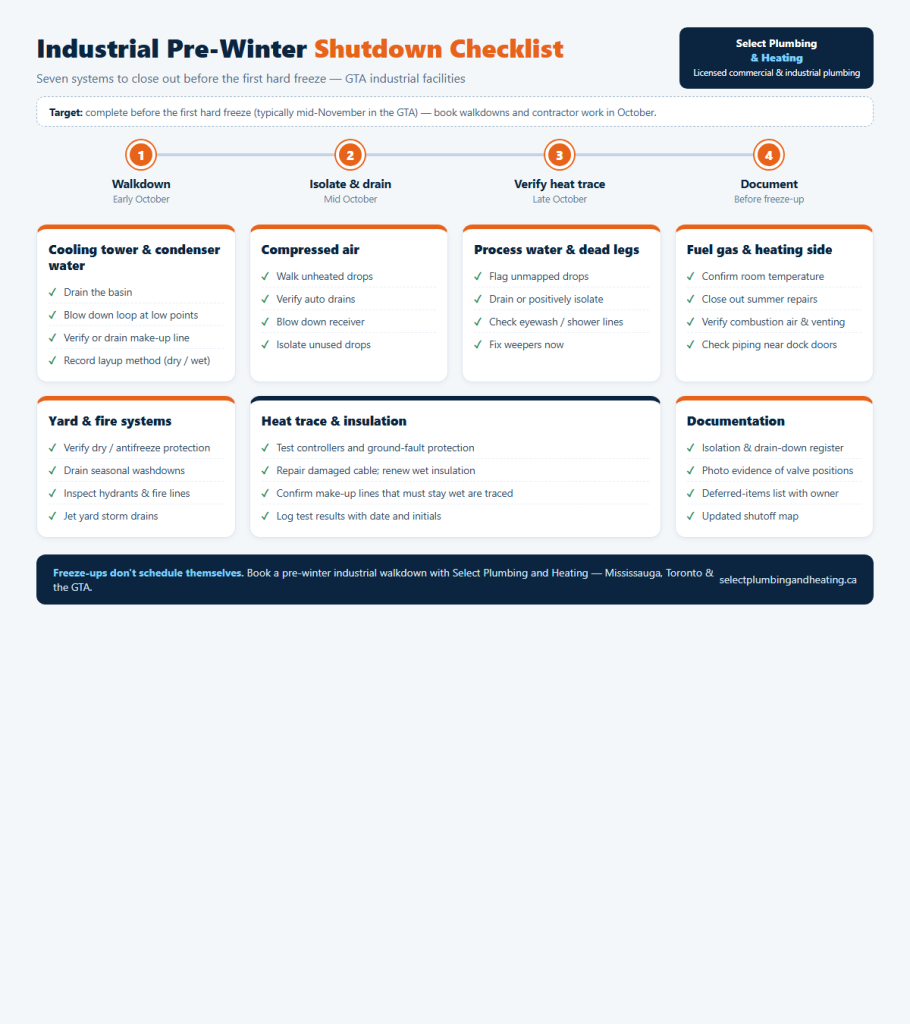
The table below consolidates the system-by-system tasks into a sign-off sheet a shift lead can actually use. Copy it, print it, and treat the sign-off column as the deliverable.
| System | Key tasks before freeze-up | Sign-off |
|---|---|---|
| Cooling tower & condenser water | Drain basin; blow down loop at low points; verify or drain make-up line; record layup method; secure cell | |
| Compressed air | Walk unheated drops; verify auto drains; blow down receiver; isolate unused drops | |
| Process water & dead legs | Flag unmapped drops; drain or positively isolate; check eyewash/shower lines; fix weepers | |
| Fuel gas & heating side | Confirm room temperature and make-up air; close out summer repair items; verify combustion air and venting | |
| Yard & fire systems | Verify dry/antifreeze protection; drain seasonal washdowns; inspect hydrants; jet yard storm drains | |
| Heat trace & insulation | Test controllers and ground-fault protection; repair damaged cable; renew wet insulation | |
| Documentation | Isolation register; photo evidence; deferred-items list; updated shutoff map |
What to document before freeze-up
Documentation is what turns this from a one-time cleanup into a repeatable seasonal program. Before freeze-up, capture:
- Isolation and drain-down register: every valve closed, drain opened, and line blown down, with date and initials.
- Heat trace verification record: controller settings, ground-fault test results, insulation condition, and any repairs deferred (with the risk accepted and by whom).
- Layup decisions for towers and seasonal equipment, with manufacturer references where relevant.
- Deferred-items register with an owner and target date for each open item — the honest list of what did not get done and why.
- Photo evidence of valve positions, drained low points and heat-trace repairs.
- An updated shutoff map. The fastest way to limit damage at -20°C is knowing which valve does what without hunting. The recordkeeping discipline behind all of this is described in our post on plumbing documentation for insurance and compliance.
Spring start-up also gets easier: the isolation register doubles as the start-up sequence, and the deferred-items register becomes the pre-season work order list.
Who should do the work — and when to bring in a licensed contractor
Much of this checklist is in-house work: walking drops, blowing down receivers, closing valves and photographing positions. The line between in-house tasks and licensed contractor work is mostly about system criticality and code. Once you are draining a fire line, taking a tower loop apart, or repairing process piping, the risk of a wrong-valve incident or a code issue goes up fast — and the cost of an error in January is much higher than the cost of a walkthrough in October.
A licensed industrial plumbing contractor earns their fee in three places: the walkdown itself, as a second set of eyes that has seen and repaired every failure mode on this list; heat-trace verification and repair, where the difference between “tested” and “works” is expensive; and any repair or replacement work that must be complete before freeze-up. If your shutdown window is late October, book the walkdown early — contractors’ fall calendars fill quickly once the first frost hits.
Frequently asked questions
When should a GTA industrial facility complete pre-winter shutdown work?
Target completion before the first hard freeze, typically mid-November in the GTA, with the walkdown and any contractor work booked for October. Anchor the schedule to the seasonal outlook rather than the calendar, since freeze dates move year to year.
What freezes first in an industrial building?
Almost always trapped water in dead legs and low points — unused equipment drops, deactivated washdown stations, low-point drains that were never opened after the last repair, and make-up lines where the heat trace has failed silently.
Do unused equipment drops need to be removed or just drained?
Draining protects the line for this winter only if nobody recharges it; removal or positive isolation protects every winter. For lines through unheated areas, removal or positive isolation with the position documented is the more defensible choice.
Does shutting down a cooling tower for winter need a contractor?
Draining the basin is straightforward. The judgment calls — dry versus wet layup, what to heat-trace, how to protect the loop over winter — are where a licensed contractor and the tower manufacturer’s O&M manual earn their keep.
What is the fastest way to limit freeze damage if something splits?
An accurate, up-to-date shutoff map. At -20°C, the difference between a five-minute isolation and a 40-minute valve hunt is usually the difference between a repair and a flood claim. Our post on the first 30 minutes of a commercial plumbing emergency walks through the full sequence.
Book a pre-winter industrial walkdown
Select Plumbing and Heating is a licensed commercial and industrial plumbing contractor serving Mississauga, Toronto and across the GTA. We provide seasonal shutdown walkdowns, heat-trace verification and repair, cooling tower loop and process piping drain-downs, yard fire line and hydrant work, and 24/7 emergency response through winter. Contact us to book a pre-winter walkdown or a same-day assessment of a specific system.
