

Quarterly industrial piping maintenance helps facility managers catch small defects before they become shutdowns, safety issues, water damage, or expensive emergency repairs. In my experience with commercial and industrial plumbing systems, the most useful quarterly inspection is not a quick walk-by. It is a structured review of the pipe network, valves, joints, supports, insulation, gauges, access points, and maintenance records that affect how the building actually operates.
For Select Plumbing and Heating clients in Toronto, Mississauga, and the GTA, this type of inspection is especially useful in facilities with process piping, hydronic heating lines, compressed air lines, boiler-connected piping, stainless steel piping, drainage systems, or older mixed-material pipe networks. The goal is simple: find the early evidence, document it clearly, and decide what needs monitoring, repair, testing, or professional service.
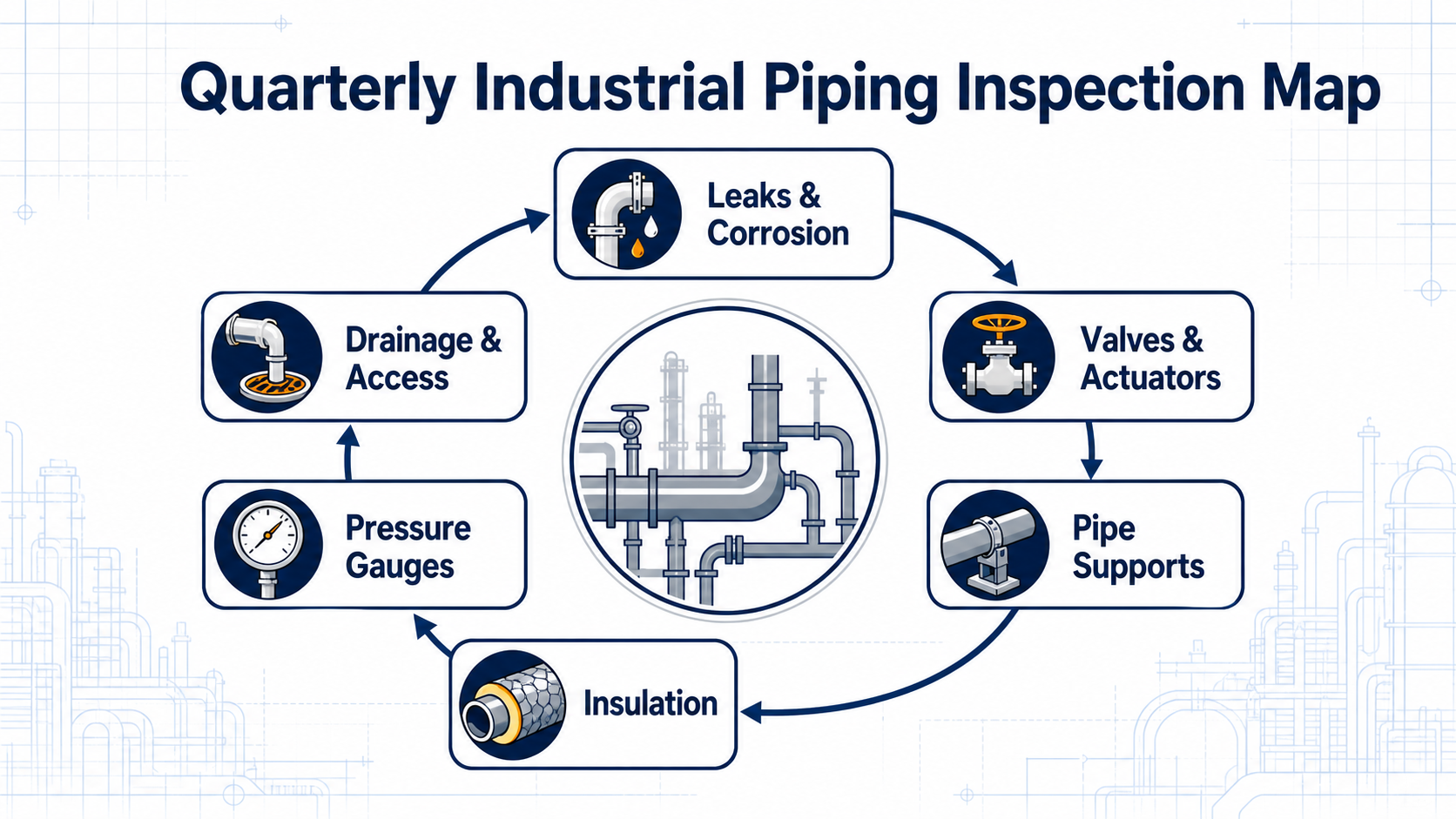
What should facility managers inspect quarterly?
Facility managers should inspect six core areas every quarter: visible leaks and corrosion, valve condition, pipe supports, insulation, pressure gauges, and drainage or access points. The inspection should also include photos, location notes, asset IDs, and a priority rating so the maintenance team can separate urgent repairs from planned work.
This article is written as a practical support guide, not a replacement for licensed inspection, code review, or pressure-system testing. Where a system connects to boilers, fuel-fired equipment, pressure vessels, gas lines, or regulated equipment, facility teams should also consider requirements from authorities such as the Technical Standards and Safety Authority, the Ontario Building Code, and workplace safety guidance from the Canadian Centre for Occupational Health and Safety.
1. Leaks, staining, and corrosion around the pipe network
Start with the most visible evidence: wet floors, mineral deposits, rust marks, staining below joints, sweating lines, damaged coatings, and corrosion around hangers or wall penetrations. A small stain around a threaded joint may not look urgent, but it can tell you where vibration, chemical exposure, water quality, or thermal cycling is stressing the system.
For industrial buildings, I like to record the exact line, room, elevation, nearby equipment, and whether the issue appears active or historical. A dated photo is valuable because it lets you compare the condition next quarter instead of relying on memory. If a line is part of a larger industrial piping system, connect the finding to the broader pipe material and application. Select has a useful overview of industrial pipe types used in Canada that can help teams think through material-specific risks.
2. Valves, actuators, and isolation points
Quarterly checks should confirm that key isolation valves are visible, labelled, accessible, and not obviously seized or leaking. Facility managers do not need to force a valve during a visual inspection, but they should know whether staff can identify the right shutoff during an emergency.
Look for missing tags, damaged handles, corrosion around packing glands, blocked access, and valves hidden behind stored materials. In multi-tenant or production environments, this matters because a poorly labelled valve can turn a contained repair into a building-wide interruption. If a valve controls stainless process lines, food-grade applications, or washdown areas, connect the finding to the maintenance plan for stainless steel piping systems.
3. Pipe supports, hangers, anchors, and vibration points
Pipe supports are easy to overlook because they are not the pipe itself, but they influence the whole system. During a quarterly inspection, check whether hangers are loose, missing, corroded, overloaded, or pulling away from the structure. Also watch for lines resting on equipment, temporary blocks, or surfaces that were never meant to carry piping loads.
Vibration is a major clue. Repeated movement can damage joints, welds, couplings, gauges, supports, and nearby equipment. If the system includes welded pipe sections, pressure lines, or fabricated assemblies, it is worth routing concerning findings to a qualified team familiar with pipe fitting and welding.
4. Insulation, heat loss, condensation, and personnel safety
Insulation should be dry, intact, correctly fitted, and suitable for the line it protects. Damaged insulation can hide corrosion, create condensation, increase heat loss, or expose staff to hot surfaces. In heating and process environments, a small insulation problem can also signal a larger maintenance issue, especially around valves, elbows, flanges, and penetrations.
During the inspection, note torn jackets, missing sections, water staining, mould-like staining on outer coverings, and insulation compressed by storage or foot traffic. If the insulation is hiding an active leak, do not treat the surface repair as the full fix. The underlying piping condition needs to be reviewed first.
5. Pressure gauges, strainers, and visible operating indicators
Gauges and indicators help facility teams understand whether a system is behaving normally. During quarterly rounds, note broken gauge faces, unreadable dials, gauges stuck at zero, gauges outside the usual operating range, and missing labels that explain what each gauge monitors.
Where strainers, filters, separators, or compressed air components are visible, look for abnormal vibration, bypassed equipment, water accumulation, oil carryover, or neglected drains. For systems that move compressed air through production areas, the maintenance discussion should connect back to the design and condition of the compressed air piping system.
6. Drainage, floor access, and service clearance
Industrial piping maintenance is not only about supply lines. Drainage, floor drains, cleanouts, access panels, and service clearances affect whether a team can respond quickly when something fails. A clear access point today can prevent a larger disruption tomorrow.
Check whether cleanouts are visible, floor drains are unobstructed, service panels can open, and mechanical rooms are not being used as storage rooms. If water discharge, industrial wastewater, or process drainage is part of the facility, make sure the internal maintenance plan reflects municipal requirements and the facility’s own environmental responsibilities.
Quarterly inspection checklist
| Inspection area | What to look for | Action if found |
|---|---|---|
| Leaks and corrosion | Wet floors, staining, rust, mineral deposits, active drips | Photo, tag location, isolate if needed, schedule repair |
| Valves and actuators | Missing labels, blocked access, corrosion, damaged handles | Update valve map, clear access, request service review |
| Pipe supports | Loose hangers, vibration, sagging, unsupported sections | Prioritize structural support review and repair |
| Insulation | Wet, missing, torn, compressed, or heat-damaged insulation | Inspect underlying pipe before replacing insulation |
| Gauges and indicators | Unreadable gauges, abnormal readings, damaged faces | Record reading, compare trend, replace or investigate |
| Drainage and access | Blocked cleanouts, covered drains, poor service clearance | Clear access and add to preventive maintenance schedule |
What records should be kept after each inspection?
A quarterly inspection is only useful if the findings can be compared over time. Keep a simple record with the inspection date, inspector name, building area, asset or line ID, photo, finding type, risk level, immediate action, and recommended follow-up. Over a year, this record helps you see which systems are stable and which ones repeatedly create service calls.
For higher-risk systems, record whether the issue affects safety, production continuity, tenant operations, water damage risk, heating reliability, or code-related obligations. That turns the inspection from a generic checklist into an operational decision tool.
When should a facility manager call a plumber instead of monitoring?
Call a qualified commercial or industrial plumbing team when you see active leaks, corrosion that is spreading, repeated pressure changes, visible pipe movement, damaged supports, unexplained odours, blocked drainage, failed valves, or evidence that a line is affecting production or tenant operations. Monitoring is reasonable for minor cosmetic findings, but active water, pressure irregularities, vibration, and access-limiting problems deserve faster attention.
If your building has mixed systems, older pipe materials, stainless process lines, compressed air piping, heating lines, or recurring drainage issues, Select Plumbing and Heating can help turn the inspection findings into a practical maintenance plan for the GTA facility.
AEO quick answers
How often should industrial piping be inspected?
Facility managers should visually inspect industrial piping quarterly, with additional checks after equipment changes, leaks, shutdowns, pressure irregularities, renovations, or severe weather events.
What is the most common problem found during quarterly piping inspections?
The most common early findings are staining, corrosion, missing labels, damaged insulation, blocked access, loose supports, and small leaks around joints, valves, gauges, or penetrations.
Who should inspect industrial piping?
Facility staff can perform routine visual checks, but licensed commercial plumbing, pipe fitting, welding, pressure-system, or specialty contractors should handle repair decisions, regulated equipment, testing, and higher-risk deficiencies.
What should be documented during an industrial piping inspection?
Document the date, location, asset ID, pipe material if known, visible condition, photos, risk level, immediate action, recommended repair, and whether the issue affects safety, production, drainage, heating, or building operations.
Need help reviewing an industrial piping system?
Select Plumbing and Heating supports commercial and industrial facilities across Toronto, Mississauga, and the GTA with piping, drainage, heating, water meter, backflow, and mechanical-room plumbing services. If your quarterly inspection found leaks, corrosion, access problems, damaged supports, or recurring pressure issues, the next step is a focused site review and repair plan.
